
Emerging Trends in Cloud Computing, Artificial Intelligence (AI) and the Internet of Things (IoT)
Cloud Computing, the Internet of Things (IoT), and Artificial Intelligence (AI) are three rapidly evolving technologies that are reshaping industries and daily life (Saadia, 2021). Cloud Computing, as defined by Google Cloud, involves the delivery of computing services, such as data storage and processing, over the internet. IoT, on the other hand, refers to the interconnection of physical devices, vehicles, buildings, and other objects embedded with electronics, software, sensors, actuators, and network connectivity, enabling them to collect and exchange data (Ray, 2017). Artificial Intelligence (AI) focuses on developing intelligent agents capable of reasoning, learning, and problem-solving (Sagar, 2024).
This cross-analysis explores the interdependencies, shared trends, and distinct developments among these three technologies. By understanding their synergies and interactions, we identified potential applications and assessed their impact on various industries, such as healthcare, finance, and manufacturing. The Venn diagram below visually represents the commonalities, intersections, and unique aspects of these technologies, highlighting their potential to drive innovation and transformation.
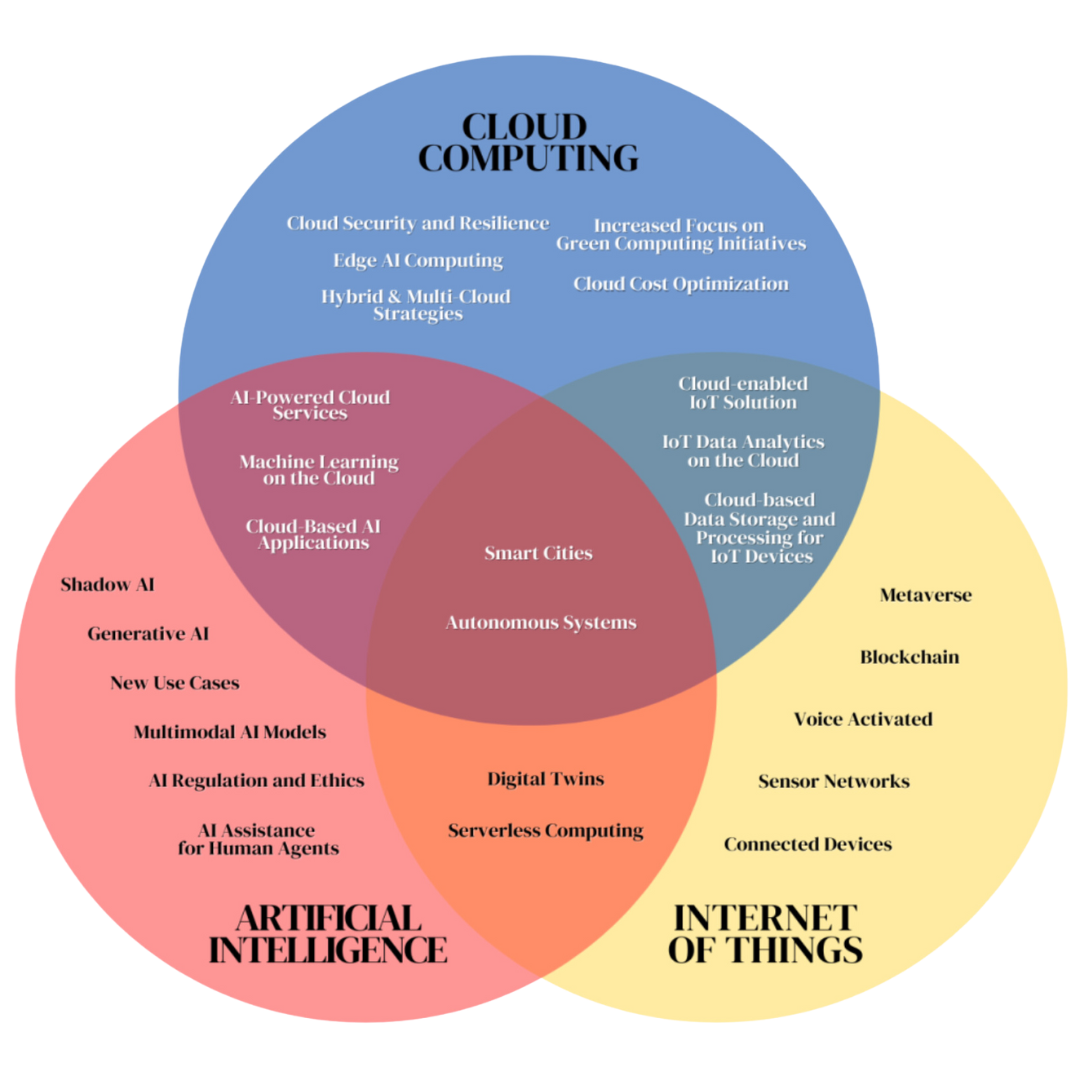
The convergence of Cloud Computing, Artificial Intelligence, and the Internet of Things is revolutionizing various industries. Cloud computing provides the infrastructure to store and process vast amounts of data generated by IoT devices. AI algorithms analyze this data to extract valuable insights, enabling predictive analytics and automated decision-making. This synergy empowers organizations to optimize operations, enhance customer experiences, and develop innovative products and services.
In healthcare, AI-powered cloud solutions can analyze medical records to identify patterns and predict disease outbreaks. IoT devices can monitor patient health in real-time, enabling remote monitoring and early intervention. In finance, AI algorithms can detect fraudulent transactions and assess creditworthiness, while IoT devices can secure physical assets. In manufacturing, AI-driven IoT systems can optimize supply chains, predict equipment failures, and improve quality control.
As these technologies continue to evolve, we can expect even more groundbreaking applications. The future holds the promise of autonomous vehicles, personalized medicine, and smart cities, all powered by the combined strength of Cloud Computing, AI, and IoT.
Reflection of Each Group Member
As a group, we delved into the intricacies of Cloud Computing, IoT, and AI. We were amazed by the transformative power of these technologies and their potential to revolutionize industries.
Daniel James Abobo noted that these trends have the potential to benefit many industries and streamline processes. For example, in healthcare, AI-powered diagnostics can improve accuracy and efficiency, while IoT devices can monitor patient health in real-time.
Sharmagne Gamboa emphasized the significance of cloud computing in today's technological landscape, highlighting the benefits of hybrid and multi-cloud strategies, edge AI computing, and serverless computing. She also emphasized the importance of addressing ethical concerns, such as sustainability and cost management, in cloud computing.
Rhysa Caruz was amazed by the advancements in these technologies and their impact on various industries, including business, banking, and agriculture. She highlighted the increased speed, accuracy, and security enabled by these technologies. For instance, AI-powered chatbots can provide instant customer support, while blockchain technology can ensure the security and transparency of financial transactions.
Gwyneth Miasco delved into the world of AI, focusing on generative AI and multimodal AI models. She discussed the potential of AI to enhance healthcare, but also highlighted the importance of addressing ethical concerns like shadow AI and AI regulation. Generative AI can be used to create realistic images, videos, and text, but it can also be misused to generate misinformation or deepfakes. Multimodal AI models can process and understand information from various sources, such as text, images, and audio, enabling more sophisticated applications. However, it is crucial to develop AI systems that are fair, unbiased, and transparent.
Carl Ian James Pepito explained the synergy between cloud computing, IoT, and AI in enabling edge AI computing, digital twins, and smart cities. He also emphasized the role of 5G technology and blockchain in securing IoT ecosystems. Edge AI computing brings AI capabilities closer to the data source, reducing latency and enabling real-time decision-making. Digital twins are virtual replicas of physical objects or systems, which can be used for simulation, optimization, and predictive maintenance. While, smart cities utilize IoT devices, AI, and cloud computing to improve urban living and sustainability.
By combining these insights, we can appreciate the full potential of these technologies to shape the future and drive innovation across various sectors.